
Receipts attached 1 source
Sources
-
Other source
Boston Landmarks Commission nomination report
Limits
October 8 city report describes September 9 state action. Federal approval not verified or claimed. City rehabilitation-tax-credit description is not individualized tax advice; designation alone does not award credits.
Corrections
No correction notes have been added for this article.
Two Boston historic district nominations have passed a state review and moved toward federal consideration, putting a section of downtown’s financial core and a smaller Jamaica Plain corridor on parallel preservation tracks. The city reported the development October 8, following a September 9 vote by the Massachusetts Historical Commission’s State Review Board.
The nominations cover the Historic Exchange District and Green Street East Historic District. The vote sends them to the National Park Service for final review. It does not mean federal listing has already occurred.
Boston historic district nominations reach different economies
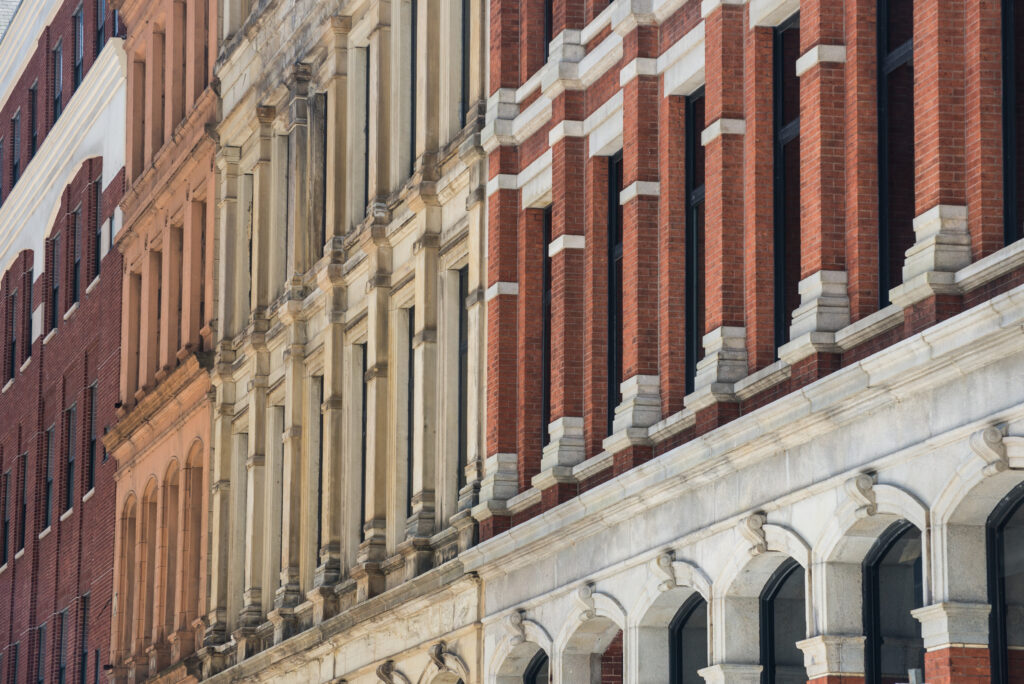
The Boston Landmarks Commission’s account describes the Exchange District as approximately 18 acres centered around Devonshire and Water streets. Its development from 1883 to 1931 followed the Great Fire of 1872 and brought together banks, insurers, brokers, law offices and businesses connected to regional manufacturing and trade.
The area’s early skyscrapers record the use of elevators and steel frames as Boston’s commercial center grew upward. The nomination is also connected to a present-day problem: how to find new uses for older downtown office buildings.
The city says its preservation staff advanced the nomination partly to encourage investment and support the office-to-residential conversion program. Contributing buildings may be able to combine conversion incentives with historic rehabilitation tax credits. That is a possible financing route, not a statement that every office building in the area can or will become housing.
Green Street’s smaller-scale industrial history
Green Street East tells a different story of economic growth. Within the larger Washington-to-Amory corridor, the proposed district concentrates on buildings between Brookside Avenue and Greenley Place. The city’s accompanying map identifies 11 contributing resources.
Green Street was laid out in 1836 to connect Washington Street with the Boston and Providence Railroad, according to the nomination account; a station opened in 1841. Transportation, Stony Brook and successive forms of street transit supported workshops, housing and neighborhood businesses.
Buildings associated with that history include stables, carriage factories and a paint shop, as well as houses and apartment buildings. The Friends of Historic Green Street, with support from the Legacy Fund, organized the nomination effort and commissioned research. The city frames that documentation as particularly relevant while investment changes the surrounding Washington Street corridor.
Recognition is not a blanket development rule
National Register status is different from becoming a Boston Landmark or entering a local historic district. The city says it does not, on its own, require private owners to seek Boston Landmarks Commission design approval for ordinary privately funded work, restore a building or open it to the public.
The financial possibilities also come with conditions. The city describes Massachusetts and federal rehabilitation credits of up to 20 percent each of qualified expenditures. Projects must be certified and satisfy preservation standards. Listing does not automatically produce a tax-credit award.
The immediate outcome is therefore procedural but consequential: two researched nominations have cleared the required state step. Whether federal recognition follows, and which rehabilitation projects can use it, remains separate from that vote. For downtown and Jamaica Plain alike, the proposed recognition is being advanced as a tool for adaptation, not simply an instruction to leave everything untouched.